Air Quality Testing in Fort Myers, FL
Professional Indoor Air Quality Testing Services
Get clear answers about your indoor air with our professional air quality testing services. We measure mold spores, allergens, and environmental contaminants affecting your health and comfort. Our certified specialists provide professional air quality testing in Fort Myers, FL, helping homeowners and business owners understand airborne contamination levels in Southwest Florida’s humid climate.
- Certified air quality sampling professionals
- Accredited laboratory analysis
- Clear, actionable reports you can understand
Air quality testing evaluates a broad range of airborne contaminants, while mold testing focuses specifically on identifying and analyzing mold spores and species.
What Is Air Quality Testing?
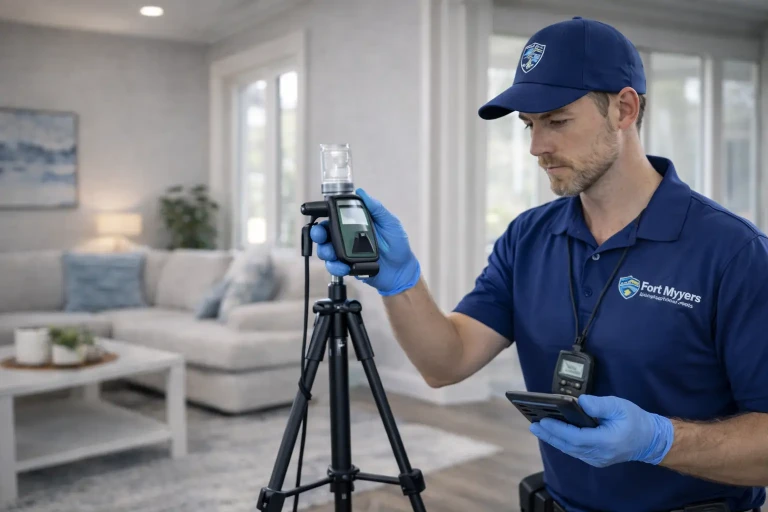
Our professional air quality testing service analyzes your indoor environment to identify airborne contaminants including mold spores, bacteria, allergens, particulates, and other pollutants affecting your health.
You can see visible mold on surfaces, but the biggest health impact often comes from invisible airborne spores circulating through your property every time you breathe. In Fort Myers homes and commercial buildings, year-round air conditioning use and high outdoor humidity often contribute to elevated indoor spore levels and ventilation challenges.
Our testing reveals:
Airborne mold spore concentrations throughout your property. Specific mold types in your breathing air. Contamination sources spreading through HVAC systems. Whether your ventilation and filtration systems are working. If your indoor air quality meets acceptable health standards.
This scientific assessment guides health protection, cleanup planning, and verification that your living or working environment is safe.
Why Air Quality Testing Matters
Indoor air quality directly impacts your health, productivity, and quality of life. In Fort Myers, where humidity remains high for much of the year, indoor environments can trap moisture and airborne contaminants if ventilation systems are not properly balanced.
Most of us spend about 90% of our time indoors, where air pollutant levels often run 2-5 times higher than outside.
Poor air quality causes:
Respiratory symptoms like coughing, wheezing, and shortness of breath. Allergic reactions with sneezing, congestion, and watery eyes. Asthma attacks and worsening of chronic conditions. Constant fatigue and trouble concentrating. Headaches and sinus problems. Long-term health effects from ongoing exposure.
People at highest risk:
Children whose developing lungs are especially vulnerable. Elderly individuals with decreased immune function. Pregnant women who need protection for fetal development. Asthma patients facing trigger exposures. Anyone with weakened immune systems at risk for serious infections.
Without testing, you’re operating blind to invisible threats circulating through your indoor spaces.
Testing provides critical answers:
Confirms whether health symptoms relate to your indoor air. Identifies specific contaminants that need fixing. Establishes baseline conditions for tracking improvement. Verifies your HVAC system performance and filter effectiveness. Documents conditions for insurance, legal, or regulatory needs.
Schedule Your Air Quality Test
Get real answers about what’s in your indoor air.
What We Test For
Mold Spore Analysis
Airborne mold spores are the most common indoor air quality concern. Spores easily become airborne and circulate through properties via air movement and HVAC systems.
Our air sampling captures:
Total spore concentrations in different areas. Specific mold types present. Relative proportions of different molds. Spore size distribution affecting how they deposit in your lungs.
How we sample:
We use calibrated air pumps that draw known volumes of air (typically 75-150 liters) through collection cassettes over specific time periods (usually 5-10 minutes). Collection media captures airborne particles for lab analysis.
We sample multiple locations:
Rooms with suspected contamination. Unaffected areas for comparison. Outside for baseline conditions. Near HVAC returns to check system-wide distribution.
Single-point measurement gives limited information. We sample multiple locations to reveal contamination patterns and sources.
Because airborne mold spores are a major indoor air concern, professional mold testing is often included as part of comprehensive air quality assessments.
Particulate Matter Measurement
Particulate matter (PM) includes tiny solid particles and liquid droplets suspended in air. Sources include combustion (cooking, candles, fireplaces), outdoor pollution infiltrating indoors, indoor activities (cleaning, moving around), biological sources (skin cells, pet dander), and building materials (insulation fibers, deteriorating surfaces).
Particle size determines health impact:
PM10 (particles ≤10 micrometers): Inhalable particles reaching your upper respiratory system, causing irritation and aggravating asthma.
PM2.5 (particles ≤2.5 micrometers): Fine particles penetrating deep into lungs and entering your bloodstream, linked to heart problems, respiratory disease, and premature death.
Ultrafine particles (<0.1 micrometers): Smallest particles crossing the lung-blood barrier, potentially reaching organs throughout your body.
We use real-time laser particle counters measuring concentrations across different size ranges, showing baseline levels during normal conditions, spikes from specific activities or sources, filter effectiveness, and comparison to health standards.
Allergen Testing
Common indoor allergens trigger respiratory symptoms and allergic reactions in sensitive people.
Major allergen categories we test for:
Biological allergens: Dust mite proteins, pet dander (cats, dogs), cockroach allergens, and rodent proteins.
Environmental allergens: Pollen infiltrating from outdoors, mold spores, and plant materials.
We use dust sampling and analysis to quantify specific allergen concentrations in settled dust, revealing accumulation patterns and exposure levels. Air sampling measures airborne allergen levels during normal activities when particles become suspended.
Understanding allergen sources guides targeted solutions including better cleaning protocols, HVAC filter upgrades, moisture control (dust mites love humidity), and source removal when possible.
Volatile Organic Compounds (VOCs)
Volatile organic compounds are gases emitted from various solid and liquid sources in your home or business.
Common VOC sources:
Building materials (plywood, particleboard, adhesives). Paints, varnishes, and finishes. Cleaning products and disinfectants. Air fresheners and scented products. Office equipment (printers, copiers). Furnishings (carpets, upholstery).
Common indoor VOCs we test for:
Formaldehyde from pressed wood products and insulation. Benzene from stored fuels and tobacco smoke. Toluene from paints and adhesives. Xylene from paints and cleaning agents. Acetone from household products.
Health effects vary by compound and concentration:
Short-term exposure causes eye, nose, and throat irritation, headaches, dizziness, and nausea. Long-term exposure to certain VOCs increases cancer risk and causes liver, kidney, or nervous system damage.
Our VOC testing:
Air samples collected in specialized canisters or sorbent tubes. Lab analysis using gas chromatography-mass spectrometry (GC-MS). Identification and quantification of individual compounds. Comparison to health-based reference levels.
Carbon Dioxide & Ventilation Assessment
Carbon dioxide (CO2) doesn’t cause health problems at typical indoor levels, but it’s a great indicator of whether your ventilation is working properly.
Humans exhale CO2, so elevated indoor levels mean you’re not getting enough fresh air to dilute occupant-generated contaminants.
CO2 concentration guidelines:
- Outdoor baseline: ~400-450 ppm (parts per million)
- Good indoor air quality: <1,000 ppm
- Acceptable: 1,000-1,500 ppm
- Marginal: 1,500-2,000 ppm
- Poor (inadequate ventilation): >2,000 ppm
Elevated CO2 correlates with:
Increased airborne transmission of respiratory infections. Higher concentrations of body odor and other occupant-generated contaminants. Decreased cognitive function and productivity. Increased complaints of stuffiness and discomfort.
Our real-time CO2 monitoring reveals ventilation patterns throughout the day, identifying times when ventilation is inadequate, areas with poor air circulation, how occupancy impacts air quality, and HVAC system performance issues.
Humidity & Moisture Assessment
Relative humidity dramatically impacts indoor air quality, mold growth, and your comfort.
Optimal indoor humidity: 30-50% RH prevents both excessive dryness and moisture problems.
Low humidity (<30% RH) causes:
Dry skin and respiratory irritation. Increased susceptibility to infections. Static electricity problems. Damage to wood furnishings and musical instruments.
High humidity (>60% RH) promotes:
Mold and bacterial growth. Dust mite proliferation. Condensation on cold surfaces. Musty odors.
We use continuous humidity monitoring with data-logging hygrometers to reveal humidity patterns throughout day and night, seasonal variations requiring system adjustment, effectiveness of humidification or dehumidification equipment, and areas with localized moisture problems.
Specialized Air Quality Services
HVAC System Assessment
Your heating, ventilation, and air conditioning system distributes air throughout your property, making it critical to indoor air quality. Because Fort Myers properties rely heavily on air conditioning throughout the year, HVAC systems can become major distribution pathways for mold spores and airborne contaminants if not properly maintained
Our HVAC testing evaluates:
Airflow volumes and distribution patterns. Filter efficiency and contamination. Duct cleanliness and microbial growth. Supply/return air quality differences. Outside air introduction rates.
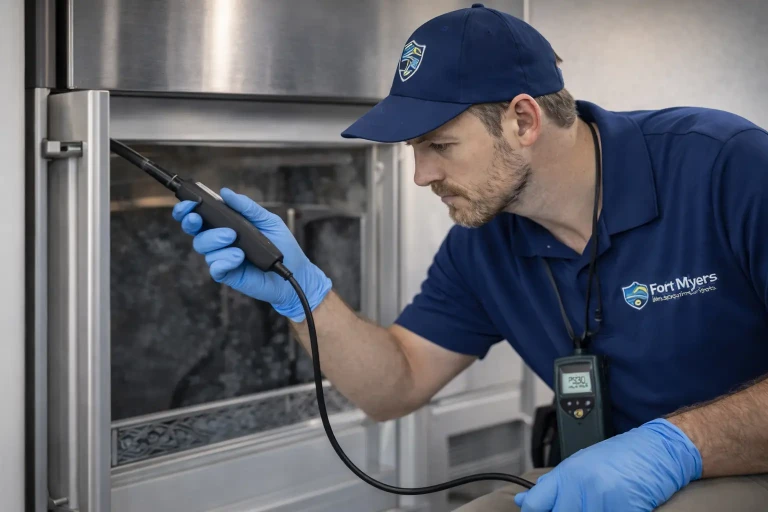
We collect surface samples from accessible ductwork, revealing microbial contamination on interior surfaces, dust accumulation reducing air quality, and whether duct cleaning is warranted.
Contaminated HVAC systems continuously reintroduce spores and contaminants even after source cleanup, defeating your remediation efforts unless system contamination is addressed.
Bacterial Assessment
While mold gets most of the attention, bacterial contamination also impacts indoor air quality.
Airborne bacteria come from occupants (respiratory droplets), organic materials (food, waste), water-damaged materials, and HVAC system biofilm growth.
Our bacterial testing methods:
Air sampling using viable collection onto growth media. Incubation and colony counting. Identification of bacterial types. Assessment of pathogenic species presence.
Elevated bacterial levels indicate:
Inadequate ventilation. Contaminated HVAC systems. Sewage or wastewater intrusion. Decomposing organic materials.
Certain bacterial species (Legionella in water systems, pathogenic Staphylococcus) create serious health risks requiring immediate action.
Odor Investigation
Persistent unexplained odors often indicate underlying air quality problems.
Common odor sources:
Microbial growth (mold, bacteria). Sewage gases from plumbing issues. VOC emissions from materials or products. Combustion byproducts. Decomposing materials.
Our odor investigation includes:
VOC sampling identifying chemical sources. Microbial testing for biological odors. Inspection of potential source areas. HVAC system evaluation for distribution pathways.
Identifying and eliminating odor sources improves air quality and occupant comfort while addressing potentially serious underlying problems.
Our Testing Process
Baseline Assessment
We start by establishing your current conditions before any remediation or improvements.
Baseline testing includes:
Multiple indoor sample locations (affected and unaffected areas). Outdoor control sample. HVAC system samples when relevant. Continuous monitoring for parameters like humidity and CO2.
This baseline data guides what needs priority attention and provides comparison for post-improvement verification.
Continuous Monitoring
Some parameters benefit from continuous measurement rather than single-point sampling.
Our data-logging monitors track real-time changes in:
Particulate matter concentrations. Temperature and relative humidity. Carbon dioxide levels. VOC concentrations (with appropriate equipment).
This reveals:
Patterns not evident from single measurements. Impacts of specific activities or system operation. Effectiveness of interventions. Optimal timing for follow-up sampling.
Post-Improvement Verification
After remediation, system improvements, or interventions, we perform follow-up testing to confirm effectiveness.
We compare:
Post-improvement results to baseline conditions. Current levels to health-based standards. Indoor conditions to outdoor reference.
Successful interventions show:
Reduced mold spore concentrations. Decreased particulate matter levels. Improved CO2 and ventilation metrics. Eliminated or reduced target contaminants.
When air quality testing confirms contamination above acceptable levels, mold remediation may be required to safely restore indoor air quality. Failed verification testing means additional work is needed before declaring problems resolved.
Understanding Your Results
We provide clear, easy-to-understand reports with professional interpretation considering multiple factors beyond raw numbers.
Comparison to Standards
We compare your results to guidelines from:
WHO (World Health Organization) – health-based air quality guidelines for various pollutants.
EPA (Environmental Protection Agency) – reference concentrations and air quality standards.
ASHRAE (American Society of Heating, Refrigerating and Air-Conditioning Engineers) – ventilation and indoor air quality standards for buildings.
Our reports clearly note any exceedances requiring intervention.
Context & Patterns
Individual results require contextual interpretation. We analyze how your indoor levels compare to outdoor conditions, whether elevated levels are consistent across multiple locations or isolated, how levels have changed from baseline or previous testing, and what activities or conditions may explain results.
Pattern recognition identifies sources:
Single-location elevation suggests localized contamination. Building-wide elevation indicates systemic issues. Temporal patterns reveal activity or system-operation relationships. Outdoor correlation suggests infiltration versus indoor amplification.
Health Risk Assessment
Results inform but don’t solely determine health risk.
Factors affecting health risk include:
Contaminant types and concentrations. Exposure duration and frequency. Individual susceptibility and health status. Presence of multiple simultaneous exposures.
Health risk assessment should involve medical professionals familiar with environmental health, particularly for vulnerable populations or when symptoms are present.
Air Quality Improvement Strategies
Click to see detailed improvement strategies
Testing identifies problems; improvement requires targeted interventions.
Source Control
The most effective approach eliminates or reduces contaminant sources:
- Remediate water damage and microbial growth
- Select low-VOC materials and products
- Maintain HVAC systems to prevent biological growth
- Fix moisture problems that promote allergen sources
- Eliminate unnecessary chemical sources
Ventilation Enhancement
Adequate ventilation dilutes contaminants to acceptable levels:
- Increase outdoor air introduction rates
- Improve air distribution to prevent stagnant zones
- Use spot ventilation such as bathroom and kitchen exhausts
- Balance building pressurization to prevent uncontrolled infiltration
Filtration Improvement
Enhanced filtration captures airborne contaminants:
- Upgrade HVAC filters to MERV 11–13 or higher
- Ensure proper filter fit to prevent air bypass
- Maintain regular filter change schedules
- Consider portable HEPA filtration for problem areas
Note: Higher-efficiency filtration requires adequate HVAC system capacity to handle increased airflow resistance.
Humidity Control
Proper moisture management prevents mold growth and controls dust mites:
- Maintain 30–50% relative humidity year-round
- Use dehumidification in humid climates or seasons
- Address moisture sources such as leaks and condensation
- Ensure adequate ventilation to remove moisture from daily activities
Professional Sample Collection
Click to learn about our sampling methods
Proper sampling technique ensures accurate, representative results.
Equipment Calibration
Air sampling pumps require regular calibration to ensure accurate flow rates. Uncalibrated equipment produces unreliable results.
We use:
- Calibrated air pumps with documented flow verification
- Appropriate collection media for target analytes
- Clean sampling equipment to prevent contamination
- Proper sample handling to maintain integrity
Chain of Custody
We maintain documented chain of custody tracking samples from collection through analysis:
- Unique sample identifications
- Collection date, time, and location documentation
- Sampler identification and credentials
- Transport and storage conditions
- Laboratory receipt confirmation
Chain of custody provides legal defensibility when testing supports insurance claims, litigation, or regulatory compliance.
Sample Timing
Sampling timing affects results and interpretation.
We consider:
- Normal occupancy conditions versus vacant periods
- HVAC system operation versus off periods
- Recent cleaning or activities affecting short-term levels
- Seasonal variations in outdoor baselines
For post-remediation clearance, properties should be tested after cleaning but before reoccupation, with HVAC systems running normally when clearance requires system operation verification.
What Air Quality Testing Costs
Our professional air quality testing services vary based on scope and complexity. Pricing for air quality testing in Fort Myers varies depending on property size, number of sampling locations, and the scope of laboratory analysis required.
- Single-location mold air sampling: $150-$400 per sample location
- Multi-point air quality assessment: $600-$1,200
- Comprehensive air quality testing (multiple parameters): $800-$1,500
- VOC analysis: $300-$600
- Allergen testing: $200-$400
- Continuous monitoring (equipment rental): $200-$500 per week
- Complete building assessment: $1,500-$5,000+ Air quality testing is often performed as part of our professional mold inspection services, which typically range from $250-$600 depending on property size and assessment scope.
Value you receive: Objective data supporting health decisions. Identification of hidden problems before visible damage. Verification that improvements actually worked. Documentation for insurance or legal purposes. Peace of mind about environmental safety. This investment prevents expensive mistakes from inappropriate or ineffective interventions while protecting health through informed decision-making.
When You Need Air Quality Testing
Testing is essential when:
You suspect mold or air quality problems but can’t see the source. Someone’s experiencing unexplained health symptoms that improve when away from the property. You need post-remediation verification. You’re buying or selling property in Fort Myers and want objective air quality documentation before closing.. Indoor odors persist without clear cause. You want to verify HVAC system performance.
Testing provides answers when: Visual inspection doesn’t reveal obvious problems. You need documentation for insurance or legal purposes. Tenant or employee health concerns require objective data. You want baseline conditions before starting improvements.
Why Choose Our Air Quality Testing Services
Certified Environmental Professionals Our team holds specialized certifications in environmental sampling and uses calibrated, professional-grade equipment for accurate measurements.
Accredited Laboratory Analysis Every sample goes to accredited laboratories meeting rigorous quality standards for reliable, legally defensible results.
Comprehensive Assessment We don’t just collect samples – we provide complete environmental assessment identifying sources, patterns, and solutions.
Clear, Actionable Reports: Clients receive easy-to-understand reports outlining findings, interpretation, and recommended next steps when elevated levels are detected.
Complete Service Coverage From initial assessment through post-improvement verification, we support you through every phase of the air quality testing process.
Integration with Remediation Services When testing confirms problems requiring remediation, we work seamlessly with professional mold inspection services and cleanup teams to ensure accurate, verifiable solutions.
Schedule Professional Air Quality Testing in Fort Myers, FL
Don’t wonder what you’re breathing. Get scientific answers about your indoor environment with our professional air quality testing services.
Call now to schedule indoor air quality testing for your Fort Myers home or commercial property.
Mold spore analysis and identification. Particulate matter measurement. Allergen quantification. VOC screening and identification. Humidity and ventilation assessment. HVAC system evaluation. Post-remediation clearance verification. Continuous monitoring services.
Breathe easier with professional air quality assessment.