HVAC Mold Remediation in Fort Myers, FL
Eliminate Hidden Mold from Your Heating and Cooling System
When mold contamination spreads into your HVAC system, it distributes spores to every room in your property every time the system runs. Professional HVAC mold remediation stops this cycle and protects your indoor air quality.
Our team provides professional HVAC mold remediation in Fort Myers, FL, helping homeowners and commercial property owners eliminate mold contamination inside ductwork, air handlers, and cooling systems exposed to Southwest Florida’s humid climate.
HVAC mold remediation is one critical component of complete mold removal. If contamination is found in your heating and cooling system, it must be addressed alongside broader remediation efforts to prevent recontamination and ensure lasting results.
This service supports complete remediation projects throughout Fort Myers and surrounding Lee County communities, where year-round air conditioning creates the persistent moisture conditions that make HVAC contamination particularly common.
NADCA-Certified Professionals • Complete System Decontamination • Post-Remediation Verification
Why HVAC Systems Harbor Mold
Your heating and cooling system creates perfect conditions for mold growth while simultaneously spreading contamination throughout your property. Once mold establishes itself inside ductwork or on system components, every heating or cooling cycle pushes thousands of spores into the air you breathe.
HVAC mold develops when several factors combine. Constant moisture forms on cold evaporator coils during cooling cycles—in high-humidity climates, condensation never fully evaporates between cycles. Accumulated dust and debris on interior surfaces provide nutrition for mold colonies. Dark, enclosed environments lack UV exposure that naturally inhibits outdoor growth. Air movement constantly deposits new spores throughout the system from other contaminated areas in your property.
In Fort Myers properties, high outdoor humidity combined with continuous summer cooling often prevents coils and duct interiors from fully drying between cycles.
The Hidden Contamination Cycle
Here’s what most property owners don’t realize: you can invest in thorough remediation for visible growth in bathrooms, walls, or attics, but if contaminated ductwork isn’t addressed, the HVAC system reintroduces thousands of spores immediately after treatment is complete.
This defeats even professional remediation efforts. Surface cleaning removes visible mold, but contaminated air handlers and ductwork keep seeding new growth throughout your property. That’s why comprehensive property assessment must include HVAC evaluation before remediation begins. In Fort Myers homes, untreated HVAC contamination frequently causes recurring mold issues even after visible growth has been removed from bathrooms, attics, or wall cavities.
Health impact: Unlike mold confined to a single room, HVAC contamination creates building-wide exposure. Common patterns suggesting HVAC involvement include symptoms worsening when heating or cooling operates, improvement when the system shuts off, multiple occupants affected simultaneously, and seasonal symptom patterns matching system usage.
Schedule a complete mold inspection to determine if your HVAC system requires remediation.
Recognizing HVAC Mold Problems
Most HVAC contamination remains hidden until advanced stages. These warning signs suggest contamination requiring professional assessment:
Visible indicators: Dark spots or discoloration around supply vents or return grilles, visible mold when vent covers are removed, persistent moisture or condensation on vent covers, and musty odors strongest near vents or when the system first starts.
Performance changes: Reduced airflow from supply vents, increased energy consumption without explanation, frequent filter clogging with biological material, and unusual odors when heating or cooling activates.
Risk factors: Previous water damage or flooding, roof leaks above ductwork, plumbing leaks near HVAC equipment, inadequate condensate drainage, poor maintenance with infrequent filter changes, and systems located in unconditioned spaces like hot attics or damp crawl spaces. These conditions are especially common in Fort Myers properties where HVAC systems run most of the year to combat heat and humidity.
Any combination of these indicators warrants immediate professional evaluation as part of your complete property assessment.
Our HVAC Remediation Process
Professional HVAC remediation requires specialized equipment and procedures beyond standard duct cleaning. Our process eliminates existing contamination, addresses moisture sources, and prevents regrowth.
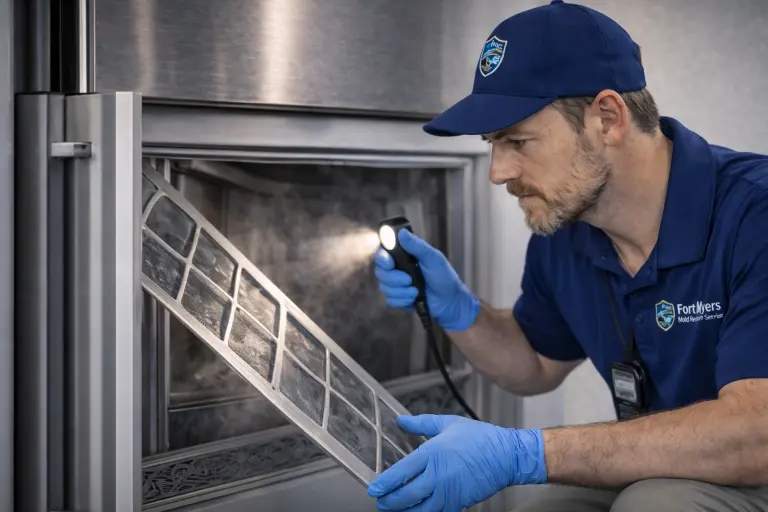
Complete System Assessment
We examine every accessible component systematically—air handler assemblies, evaporator coils, ductwork interiors, drain pans, and ventilation components. Moisture assessment identifies ongoing dampness requiring correction. When visual inspection suggests contamination, we perform HVAC-specific air sampling comparing supply air (what your system distributes) against return air and outdoor baselines.
Elevated supply air spore counts indicate contamination within HVAC components. Laboratory analysis identifies specific mold genera, determines severity, and guides our remediation approach.
Professional Cleaning and Decontamination
System shutdown and containment prevents contamination spread during cleaning. We completely shut down your HVAC system and establish containment barriers at work areas.
Duct cleaning uses powerful HEPA vacuum equipment (often truck-mounted systems) creating negative pressure that pulls dislodged debris into collection. Mechanical agitation with rotating brushes and compressed air contacts duct interior surfaces, dislodging attached dust, debris, and biological growth. We work systematically from furthest supply registers back toward the air handler, ensuring complete coverage of both supply and return ductwork.
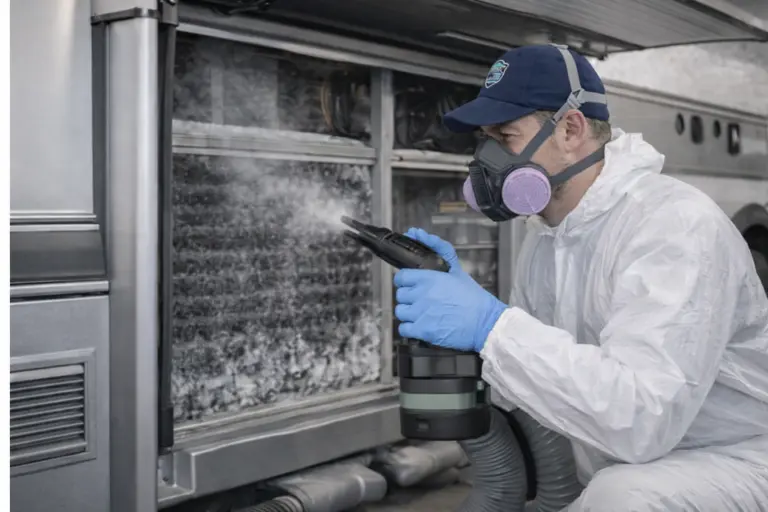
Evaporator coil treatment addresses the cooling coils where constant moisture creates prime mold habitat. We use specialized foam cleaning that penetrates between coil fins, low-pressure washing, or steam cleaning depending on contamination severity. EPA-registered antimicrobial products formulated for HVAC application treat coil surfaces, providing residual protection against regrowth.
Blower assembly cleaning removes thick biological layers from blower wheels that reduce efficiency while distributing contamination. Complete wheel removal allows thorough cleaning and antimicrobial treatment.
Condensate system service prevents standing water that supports microbial growth. We clean drain pans, clear condensate line clogs, verify proper drainage, and repair any deficiencies allowing moisture accumulation.
Component Replacement When Necessary
Severely contaminated porous materials require replacement rather than cleaning. Flex duct with contaminated interior surfaces, moisture-saturated insulation, and rusted drain pans get replaced with new components. Attempting to salvage severely contaminated porous materials often leads to rapid recontamination within months.
Post-Remediation Verification
Professional remediation isn’t complete until we verify successful decontamination. Air sampling after remediation confirms supply air spore levels at or below outdoor baseline, absence of previously identified mold species, and adequate airflow and system performance.
We operate the system for a minimum of 30 minutes before sampling, collect air samples from supply registers, include outdoor control samples for comparison, and use accredited laboratory analysis. Visual inspection confirms no visible contamination on accessible components, proper drainage, and correct reassembly.
Clients often see 10-20% energy cost reductions after professional HVAC remediation due to improved airflow and heat transfer efficiency.
Prevention and Long-Term Protection
HVAC remediation solves current contamination, but long-term protection requires addressing moisture sources and implementing preventive measures.
Filtration upgrades capture airborne contaminants before they accumulate. We recommend MERV 8-11 filters for standard residential systems or MERV 13-16 high-efficiency filters when system capacity allows. Regular filter replacement (every 1-3 months) maintains protection.
UV light systems installed near evaporator coils prevent biological growth through continuous germicidal irradiation. UV provides ongoing prevention after professional remediation addresses existing contamination.
Humidity control prevents the condensation that supports mold growth. Properly sized air conditioning equipment, adequate insulation preventing condensation on duct surfaces, and functioning condensate drainage all contribute to moisture management. Maintaining indoor humidity below 60% significantly reduces mold growth risk. In Fort Myers, maintaining proper humidity control is essential due to consistently high outdoor moisture levels.
Ongoing maintenance prevents recontamination. Monthly filter inspections, quarterly system checks, and annual professional inspection catch problems early when they’re inexpensive to address.
How HVAC Remediation Fits Into Complete Mold Removal
HVAC mold contamination rarely exists in isolation. When we find significant growth in heating and cooling systems, it almost always indicates broader moisture and mold problems throughout the property.
Why Treating HVAC Alone Usually Fails
If your property has active mold growth in bathrooms, attics, or wall cavities, treating only the HVAC system provides temporary improvement at best. Your HVAC system constantly draws air from contaminated areas through return vents, collecting spores that recolonize recently cleaned ductwork within weeks or months. Unless contamination sources are properly addressed throughout the property, the HVAC system keeps getting recontaminated.
The Correct Approach
Professional property inspection should assess your entire property, not just visible growth or HVAC components. When inspection reveals both HVAC contamination and mold in other areas, remediation must address everything simultaneously:
Source moisture correction fixes the plumbing leaks, roof damage, or humidity issues that allowed mold to establish initially. Whole-property remediation removes contaminated materials and treats affected structures throughout your home or business. HVAC remediation occurs as part of the complete project, ensuring cleaned ductwork doesn’t immediately become recontaminated. Verification testing confirms both HVAC systems and general indoor air quality meet acceptable standards.
This comprehensive approach costs more upfront than addressing only obvious problems, but it’s the only strategy providing lasting results. Treating symptoms while ignoring root causes just means you’ll pay for remediation twice.
When HVAC-Only Remediation Makes Sense
HVAC-focused remediation is appropriate when inspection confirms contamination is limited to the heating and cooling system without significant mold elsewhere, the moisture source is system-specific (like a clogged condensate drain), and air quality testing shows normal spore levels in general indoor air with elevated levels only in supply air.
Even in these cases, we recommend thorough property inspection before limiting scope. What appears to be isolated HVAC contamination often has underlying sources requiring broader remediation.
Investment in HVAC Remediation
Professional HVAC remediation costs vary based on system size, contamination severity, and whether it’s performed as part of broader property remediation. HVAC mold remediation costs in Fort Myers vary depending on system size, duct complexity, and the extent of contamination within air handling components.
Residential systems with light to moderate contamination typically range from $800-$1,500 for basic cleaning of smaller systems. Comprehensive remediation with moderate contamination or component replacement runs $2,000-$4,000. Extensive projects involving severe contamination or complex configurations can reach $4,000-$8,000+.
Commercial systems scale with building size and ductwork extent. Large commercial buildings may require $10,000-$50,000+ for complete remediation.
When HVAC remediation is part of larger projects addressing your entire property, work is coordinated with other remediation activities and priced as one component of complete scope. Final clearance testing verifies both HVAC and general air quality.
Consider what professional remediation protects: indoor air quality affecting everyone in your property, 10-20% average energy efficiency improvements, extended equipment lifespan, maintained property value, and health protection avoiding medical costs from continued exposure.
Choosing Qualified Professionals
HVAC mold remediation requires specialized knowledge beyond standard duct cleaning. Look for professionals with NADCA certification (National Air Duct Cleaners Association), mold remediation training and experience, proper equipment including HEPA vacuum systems, EPA-registered antimicrobial products, professional liability insurance, and verifiable references.
Ask contractors: What does your complete process include? Do you perform pre- and post-remediation testing? What equipment and products do you use? How do you prevent contamination spread during cleaning? Are you NADCA certified and properly insured? Avoid contractors providing extremely low bids suggesting inadequate procedures, refusing or discouraging testing, unable to provide insurance documentation, or unwilling to explain their process thoroughly.
Schedule Professional HVAC Mold Remediation in Fort Myers, FL
Don’t let contaminated HVAC systems undermine your property’s air quality and broader mold remediation efforts. Professional assessment identifies whether your heating and cooling system requires remediation and how HVAC work fits into your complete mold removal strategy.
We provide comprehensive services including complete system inspection and moisture assessment, HVAC-specific air sampling and testing, professional duct cleaning and decontamination, evaporator coil and blower treatment, condensate system service, antimicrobial treatment and protection, component replacement when necessary, filtration and UV upgrades, post-remediation verification testing, and ongoing maintenance programs.
Our team coordinates HVAC remediation with your complete property remediation project, ensuring lasting results that protect your investment and your health.
Call now to schedule HVAC mold remediation services for your Fort Myers home or commercial property: 📞 (239) 518-4848
Clean air through every vent starts with identifying the full scope of contamination—not just treating isolated symptoms.
Available 24/7 for emergency situations throughout Southwest Florida.