Vehicle Mold Remediation in Fort Myers, FL
Restore Clean, Safe, Odor-Free Vehicle Interiors
Eliminate mold contamination from cars, trucks, RVs, and boats with specialized vehicle remediation that restores safe, comfortable interiors and protects your investment. Our vehicle mold remediation in Fort Myers, FL helps car owners, RV owners, and boat owners eliminate hidden moisture contamination caused by tropical storms, flooding, and high year-round humidity common in Southwest Florida.
Vehicle mold remediation addresses a specialized subset of moisture and contamination problems. When mold affects your vehicle, it requires targeted treatment using automotive-specific methods and products. This service complements mold removal for properties, ensuring comprehensive protection whether contamination affects your home, business, or vehicles.
Our vehicle mold remediation services support vehicle owners in Fort Myers and surrounding Southwest Florida communities, where high humidity, heavy rainfall, and seasonal tropical storms create ideal conditions for automotive mold problems.
Automotive-Specific Methods • Complete Interior Decontamination • Odor Elimination Guaranteed
Why Vehicles Develop Mold Problems
Vehicles create unique environments where mold thrives due to confined spaces, moisture intrusion, temperature fluctuations, and organic materials that provide nutrition for mold growth.
Common moisture sources include compromised door seals, window seals, sunroof drains, trunk seals, and weatherstripping that allow rainwater entry during storms. Blocked AC drain tubes cause water backup into interiors, while evaporator core condensation saturates HVAC systems. Flooding events from storms, driving through high water, or parking in flood-prone areas introduce massive amounts of moisture. Even everyday activities like wet clothing, umbrellas, sports equipment, spilled beverages, and tracked-in debris contribute moisture without proper drying time.
Once moisture enters vehicle interiors, enclosed spaces with limited airflow prevent proper drying. Carpeting, upholstery, headliners, and door panels absorb and retain moisture for extended periods—plenty of time for mold establishment.
In Fort Myers, vehicles parked outdoors or stored in humid garages are especially vulnerable due to year-round humidity levels and frequent summer rainstorms that prevent interiors from fully drying.
Materials that support vehicle mold growth: Carpet padding retains moisture exceptionally well in foam layers, fabric upholstery and headliners provide porous surfaces, leather seats harbor mold growing on body oils and dirt accumulation, door panel insulation and sound deadening materials trap moisture, HVAC evaporator cores and ductwork stay persistently damp, and trunk carpeting and spare tire wells collect standing water.
Health Risks in Confined Spaces
Vehicle mold creates concentrated exposure in confined cabin spaces. Unlike buildings where you can move to unaffected rooms, vehicles offer no escape from contaminated air during use. Enclosed cabin spaces concentrate spore levels higher than typical building environments, and daily commuters spend hours weekly breathing contaminated air.
Symptoms indicating vehicle mold exposure include coughing, sneezing, or congestion during or after drives, headaches associated with vehicle use, fatigue or difficulty concentrating while driving, and eye irritation that improves when not using the affected vehicle. If multiple passengers experience similar symptoms, vehicle air quality problems exist requiring professional assessment—similar to how thorough property evaluation identifies contamination.
Schedule vehicle mold assessment and remediation: 📞(239) 518-4848
Recognizing Vehicle Mold Contamination
Early detection prevents extensive damage requiring expensive interior replacement.
Obvious indicators: Visible mold growth on seats, carpets, headliner, or door panels appearing as dark spots, white fuzz, or discoloration. Persistent musty odors especially when first entering the vehicle or operating AC. Condensation or fog on windows that won’t clear. Wet or damp carpet without obvious explanation.
Subtle warning signs: Allergic reactions or respiratory symptoms occurring specifically during drives, musty smell strongest when heating or AC first activates, discoloration or staining on fabric surfaces, peeling or bubbling door panel fabric, and deteriorating carpet backing or adhesive.
Recent history suggesting risk: Water intrusion from storms or car washes, sunroof or window left open during rain, beverage spills not properly dried, flooding or driving through deep water, AC system not cooling properly, and extended storage in humid conditions.
Vehicle mold problems often start small but escalate quickly in warm, humid environments—much like how property contamination spreads when moisture sources aren’t addressed during remediation.
Our Vehicle Remediation Process
Professional vehicle mold remediation requires specialized equipment and automotive-specific procedures beyond standard detailing services.
Complete Interior Assessment
We systematically examine every area where mold grows or moisture accumulates. Our inspection covers carpet and floor mats (lifting mats to check underneath for moisture or growth), upholstery and seats (examining fabric or leather surfaces for discoloration), headliner and visors (checking roof fabric for staining or sagging indicating moisture saturation), door panels (examining fabric surfaces especially lower sections), HVAC system (checking vents for visible contamination and assessing AC condensate drainage), and trunk or cargo areas (examining cargo floor and spare tire well for standing water).
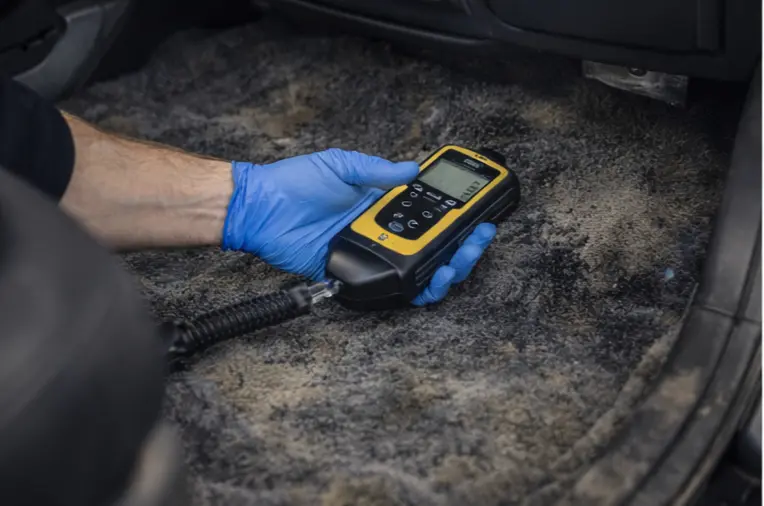
Moisture detection uses pin-type or pinless meters measuring moisture content in carpeting, padding, seats, door panels, and headliner materials. We perform leak testing simulating rain conditions to identify seal failures, check sunroof drain operation, test door seal integrity, and examine trunk seal effectiveness. Active leaks require repair before or during remediation—otherwise moisture returns immediately recreating mold-friendly conditions.
Contaminated Material Removal
Severely contaminated porous materials often require removal and replacement rather than cleaning attempts that rarely succeed long-term.
Common removals include: Carpet and padding when saturated or heavily contaminated—padding especially retains moisture and contamination making complete removal more effective than cleaning. Fabric seats with deep mold penetration may require reupholstering. Water-damaged door panels often need recovering or replacement. Saturated or extensively contaminated headliners sag and require replacement. Sound-deadening materials that absorbed water need removal.
Attempting to salvage severely contaminated materials wastes time and money while leaving contamination that returns quickly—the same principle applies to property remediation where contaminated materials can’t be adequately cleaned.
HVAC System Treatment
Vehicle AC systems harbor mold creating odors every time cooling operates. We use foaming cleaners specifically formulated for automotive AC systems, injected through drain tubes or vents. These penetrate evaporator core fins breaking down biological growth and debris. After appropriate dwell time, cleaner drains through the condensate system carrying contamination away.
Antimicrobial treatment follows cleaning, providing residual protection against regrowth. We always replace cabin air filters as part of remediation since filters trap spores becoming contamination reservoirs. Accessible ductwork receives cleaning and antimicrobial treatment ensuring proper airflow.
Deep Cleaning and Decontamination
Salvageable surfaces receive thorough cleaning and antimicrobial treatment using professional methods.
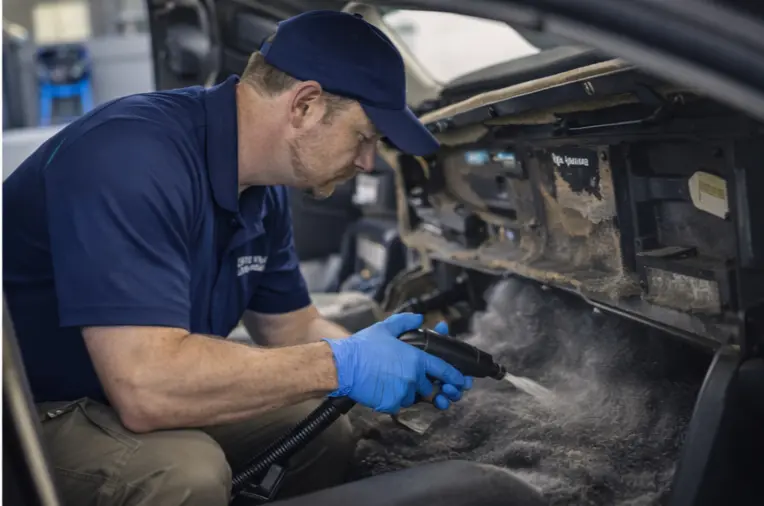
Carpet cleaning uses hot water extraction (steam cleaning) with professional truck-mounted or portable equipment removing deep contamination while sanitizing fibers. Antimicrobial shampoo formulated for automotive use treats carpet during extraction. Complete drying using high-velocity air movers prevents moisture retention that would support rapid recontamination within days.
Upholstery treatment includes extraction cleaning for fabric seats similar to carpets, specialized cleaning and conditioning for leather seats removing body oils supporting surface mold, and antimicrobial protection applied to all surfaces.
Hard surface decontamination wipes dashboard, door panels, console, and other hard surfaces with antimicrobial solution. We perform detailed cleaning of crevices, vents, and compartments, followed by protective treatment preventing future growth.
Headliner cleaning requires delicate techniques avoiding saturation that causes sagging, spot treatment of stained areas, and antimicrobial application.
Odor Elimination
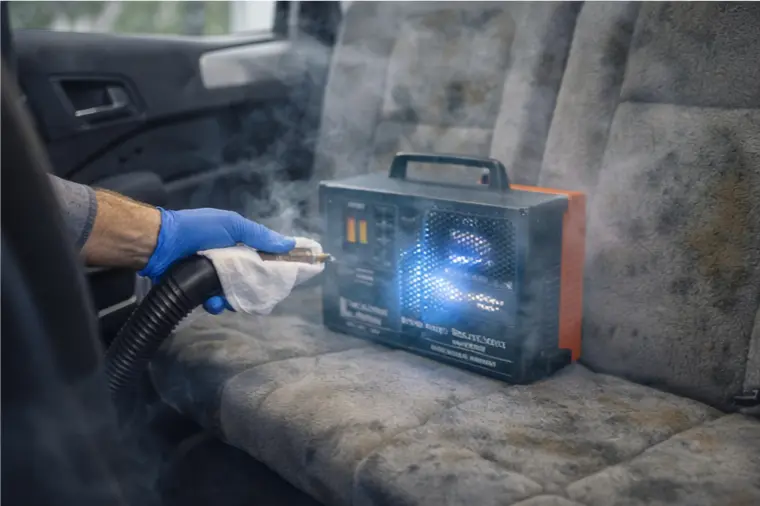
Persistent odors require specialized treatment beyond standard cleaning. High-concentration ozone generated inside sealed vehicles neutralizes odor molecules and kills remaining mold spores. Treatment requires complete vehicle sealing, several hours exposure time, and thorough ventilation before use. We also use biological odor eliminators breaking down organic compounds causing smells, applied to carpets, upholstery, and ventilation systems.
Complete Drying and Verification
Thorough drying prevents immediate recontamination. We position high-velocity air movers to maximize airflow across all surfaces, use dehumidification removing moisture from air accelerating drying, and allow extended drying time—typically 24-48 hours minimum. Rushing the drying process leaves moisture supporting rapid mold return within days, defeating the entire remediation effort.
Specialized Vehicle Services
RV and Motorhome Remediation
Recreational vehicles present unique challenges due to size, complex systems, and extended storage periods. RVs often have multiple HVAC systems (roof units, basement units), extensive cabinetry and storage areas, plumbing systems with potential leaks, roof membrane leaks common in older units, slide-out seals allowing water entry, and extended storage without climate control.
Our RV remediation includes complete interior assessment including storage compartments, treatment of multiple HVAC systems, carpet and upholstery cleaning throughout, cabinetry interior treatment, and moisture source identification and repair. RV remediation often requires on-site service due to vehicle size.
Boat and Marine Remediation
Marine vessels face constant moisture exposure creating persistent mold challenges from bilge water and humidity, deck leaks and porthole seals, cabin condensation from temperature differentials, wet gear and clothing storage, and extended periods without ventilation.
We provide bilge cleaning and treatment, cabin interior decontamination, upholstery and cushion treatment or replacement, HVAC system treatment when equipped, and moisture control strategies including ventilation and dehumidification recommendations. Marine remediation requires products compatible with saltwater environments and marine materials.
Classic and Collector Vehicle Care
Valuable collector vehicles require gentle approaches preserving original materials while eliminating contamination. We understand the importance of original upholstery and carpeting preservation when possible, use products compatible with vintage materials, employ gentle methods preventing damage to irreplaceable components, and provide documentation for insurance or resale purposes.
Moisture Source Correction and Prevention
Vehicle remediation provides temporary results without addressing moisture sources and implementing prevention strategies. In Fort Myers, common causes include storm-related water intrusion, clogged sunroof drains after heavy rainfall, and vehicles exposed to coastal humidity without adequate ventilation.
Leak Repairs
We identify and coordinate repair of water entry points preventing recurrence. Common repairs include door seal replacement (weatherstripping deteriorates allowing water entry), window seal service or replacement, sunroof drain clearing and seal maintenance, trunk seal replacement, and body rust repair preventing water intrusion. Proper sealing requires quality parts and correct installation—cheap seals fail quickly allowing moisture return.
AC System Service
Properly functioning air conditioning removes moisture preventing interior humidity problems. We verify evaporator drain tube clearing ensuring condensate exits properly, check refrigerant charge (undercharged systems cool poorly and dehumidify inadequately), and ensure blower motor operation provides good airflow.
Ventilation and Protection
Adequate ventilation prevents moisture accumulation. We recommend regular driving circulating air through the cabin, periodic window cracking allowing air exchange, climate control use removing humidity, and avoiding long-term vehicle storage in humid environments without ventilation or dehumidification.
Protective measures include moisture-resistant carpet padding replacement, waterproof floor liners instead of carpeted mats, fabric protectants creating water-resistant surfaces, and regular interior moisture checks catching problems early before they require extensive remediation.
How Vehicle Remediation Relates to Property Mold Problems
Vehicle mold contamination often indicates or accompanies property mold issues—particularly after flooding events, storms, or when vehicles are garaged in moisture-damaged buildings.
If your vehicle developed mold following water damage to your home or garage, comprehensive assessment should include both property and automotive spaces. Water intrusion affecting garages often impacts stored vehicles, while flooded properties frequently involve flooded vehicles requiring simultaneous attention.
Our team coordinates vehicle remediation with property-wide treatment when both are affected, ensuring complete protection for your family or employees. Treating only the vehicle while ignoring property contamination (or vice versa) leaves ongoing exposure risks and potential for cross-contamination.
When flooding or major water events impact both property and vehicles, professional inspection and testing should evaluate all affected areas before remediation begins, establishing the full scope of necessary work.
Investment in Vehicle Remediation
Professional vehicle mold remediation costs vary based on contamination severity and vehicle size.
Passenger vehicles: Light contamination with surface mold and odor treatment typically runs $300-$800. Moderate contamination requiring carpet cleaning and HVAC treatment ranges $800-$1,500. Severe contamination involving material removal and extensive remediation costs $1,500-$3,500+.
Larger vehicles: SUVs and vans add 20-30% to passenger car pricing. RVs and motorhomes require $1,500-$5,000+ depending on size and extent. Boats cost $1,000-$4,000+ based on vessel size and contamination severity.
Cost factors include: Contamination severity requiring material replacement, vehicle size and interior complexity, HVAC system involvement, required material replacement costs, and accessibility challenges.
When vehicle remediation occurs as part of broader water damage response including property remediation, work is often coordinated for efficiency and may be covered under insurance policies when the vehicle damage resulted from the same covered event affecting your property.
Investment protection includes: Restored vehicle value (mold damage severely reduces resale value), health protection for occupants, elimination of odors affecting driving comfort, prevention of progressive damage to interior components, and peace of mind from professional results.
DIY attempts often fail because thorough drying and hard-to-access areas require professional equipment and expertise unavailable to vehicle owners.
Choosing Vehicle Remediation Professionals
Vehicle mold remediation requires specialized knowledge beyond standard auto detailing services.
Look for professionals with experience specifically with vehicle mold remediation (not just auto detailing), professional-grade extraction and drying equipment, EPA-registered antimicrobial products safe for automotive use, ability to perform HVAC system treatment, and insurance coverage protecting your vehicle during service.
Important questions: What does your complete remediation process include from start to finish? How do you treat HVAC systems? What drying methods do you use and how long does drying take? Do you offer any guarantees on odor elimination? Can you provide references from similar vehicles?Warning signs to avoid: Extremely cheap pricing suggesting inadequate procedures, no equipment for proper extraction and drying, unwillingness to explain their process thoroughly, and pressure to add unnecessary services. Quality remediation requires time—beware of promises for same-day completion on severe contamination.
Schedule Professional Vehicle Assessment in Fort Myers, FL
Don’t tolerate musty odors and health risks from vehicle mold contamination in your Fort Myers vehicle. Professional remediation restores clean, safe, comfortable interiors protecting your investment and your health.
We provide comprehensive vehicle services including complete interior assessment and moisture testing, HVAC system cleaning and antimicrobial treatment, carpet and upholstery extraction cleaning, contaminated material removal and replacement, professional antimicrobial treatment and protection, guaranteed odor elimination procedures, complete drying and verification, leak identification and repair coordination, and specialized RV, boat, and collector vehicle services.
Our vehicle remediation services integrate with complete property treatment, ensuring comprehensive protection whether contamination affects your home, garage, business, or vehicles.
Call now to schedule vehicle assessment and remediation: 📞 (239) 518-4848
Clean, fresh vehicle interiors start with professional mold remediation using automotive-specific methods and equipment.
Available 24/7 for emergency vehicle mold remediation in Fort Myers and surrounding Southwest Florida areas.